
Iranian Rial vs Toman — Complete Guide for Expats (IRR Explained)
Iran officially uses the Rial — but in everyday life, almost everyone counts in Toman. If you follow prices from abroad, that single extra zero is the most common source of confusion.
When you try to understand Iran's economy from outside the country, one question comes up again and again: what is Iran's currency — Rial or Toman? The short answer is both, but for different purposes. This guide starts with a fast conversion cheat sheet, then walks through history, banknotes, challenges, and what may change next.
Quick reference — read this first
- Official currency: Iranian Rial (ISO code IRR)
- Everyday unit: Toman (informal, not a separate ISO currency)
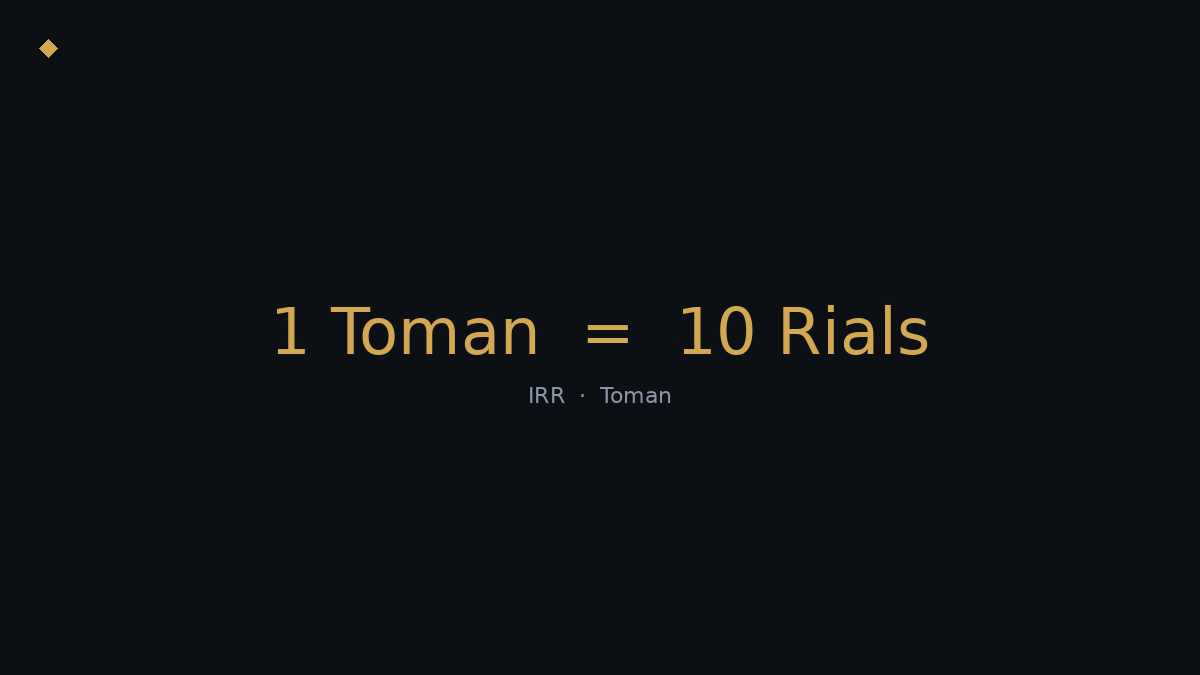
- The rule: 1 Toman = 10 Rials
- Rial → Toman: divide by 10 (drop one zero) — e.g. 1,800,000 IRR ≈ 180,000 Toman
- Toman → Rial: multiply by 10 (add one zero) — e.g. 50,000 Toman = 500,000 IRR
- Spoken prices in shops and on phone calls are usually Toman, unless someone says "rial" explicitly
- Bank cards and POS receipts show amounts in Rial
- Iran Market Data quotes prices in IRR for precision — use our IRR calculator or divide by 10 for a Toman estimate
In this guide
Official unit: Rial vs everyday Toman
Let's settle the basics first.
The Rial is Iran's legal and official currency. Under Iran's Monetary and Banking Act, the national unit of account is the Rial, and its international code is IRR. Government documents, bank ledgers, formal contracts, and the numbers on card terminals are denominated in Rial.
Toman is the unit Iranians use in daily speech. It is not a separate currency on international markets — there is no ISO code for Toman — but it dominates how people quote prices in bazaars, taxis, real-estate conversations, and family WhatsApp messages.
The relationship is fixed and simple:
1 Toman = 10 Rials
1 Toman = 10 Rials Drop one zero when converting Rial → Toman · add one zero for Toman → Rial
So the 100,000-rial banknote in your wallet is what locals call a 10,000-toman note. When our free-market dollar page shows 18,180,000 IRR, relatives in Tehran might describe the same level as roughly 1,818,000 Toman in conversation.
For diaspora readers: Always clarify which unit someone is using before sending money or comparing a quote. A missing zero is an expensive mistake.
Why Iran has two counting units
Iran did not invent two currencies on purpose. The split is a historical habit that survived a monetary reform more than 90 years ago.
Roots of the confusion
From roughly the 7th century AH through the early Pahlavi era, Toman was the dominant counting unit in Iran. In that system, one Toman equalled 10,000 dinars (the fine base unit).
In 1929 (1308 in the Iranian calendar), Reza Shah's government replaced the qiran — then the formal unit, worth 1,000 dinars — with the Rial. The new Rial was set equal to one qiran. Since one Toman had equalled ten qirans, one Toman became ten Rials overnight on paper.
People did not abandon Toman in daily life. Merchants, households, and markets kept counting the way they always had. The state standardized accounting in Rial; society kept speaking in Toman. That dual habit persists today.
Rial vs Toman — key differences
| Feature | Rial (IRR) | Toman |
|---|---|---|
| Status | Official legal currency | Informal everyday unit |
| ISO code | IRR | None |
| Typical use | Banking, government, data feeds, receipts | Conversation, street pricing, mental math |
| History as main unit | Official since 1929 | Dominant counting unit for centuries |
| Value | 1 Rial | 10 Rials |
| Convert to other | Toman × 10 = Rial | Rial ÷ 10 = Toman |
On Iran Market Data, we display IRR so diaspora readers can align with bank statements, APIs, and official tables — then mentally convert when family quotes a price in Toman.
History of Iran's currency
Iran's money story mirrors the country's long commercial history. Here is a condensed timeline.
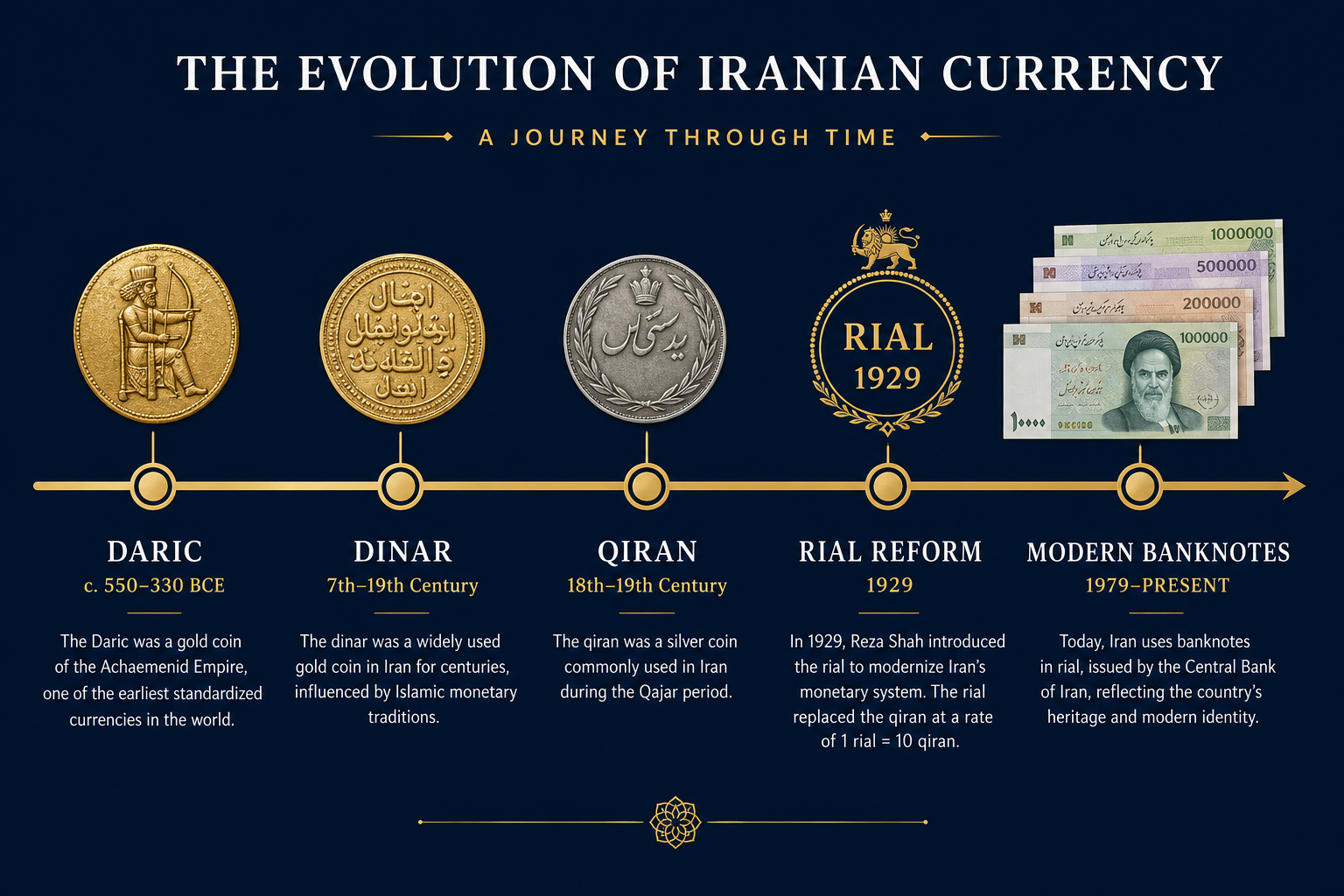
Ancient Iran: the Daric
The first widely unified Iranian coinage was the Daric, a gold coin from the Achaemenid era associated with Darius the Great. High gold purity made it trusted across ancient trade routes.
Islamic era: the dinar
After the Islamic period, the dinar — related to the Roman *denarius* — became a base unit. Larger multiples followed, including the mahmudi (100 dinars) and shahi (50 dinars) silver coins.
Safavid era: abbasi and the word "rial"
Under the Safavids, Shah Abbas minted the abbasi (200 dinars). European real coins also entered circulation through trade; the Persian pronunciation rial gradually attached to similar-weight silver pieces.
Qajar era: qiran and toman
In the Qajar period, the qiran became the formal unit (1,000 dinars). Toman — from Mongolian *tumen* ("ten thousand") — served as a larger counting block equal to 10 qirans. Nader Shah later issued a 500-dinar coin called naderi, quickly nicknamed deh shahi ("ten shahi") by the public.
Pahlavi era: the Rial reform
On 17 March 1930 (27 Esfand 1308), Iran legally adopted the Rial, replacing the qiran at par. The reform aimed to modernize and unify the monetary system — but everyday Toman survived.
Contemporary Iran
After 1979, designs on notes and coins changed, but the Rial remained the official unit. Chronic inflation eroded purchasing power over the decades. In recent years, high-denomination Iran Cheque instruments entered circulation to make large cash settlements easier.
Types of money in Iran today
Modern Iran uses banknotes, coins, and Iran Cheques in daily commerce.
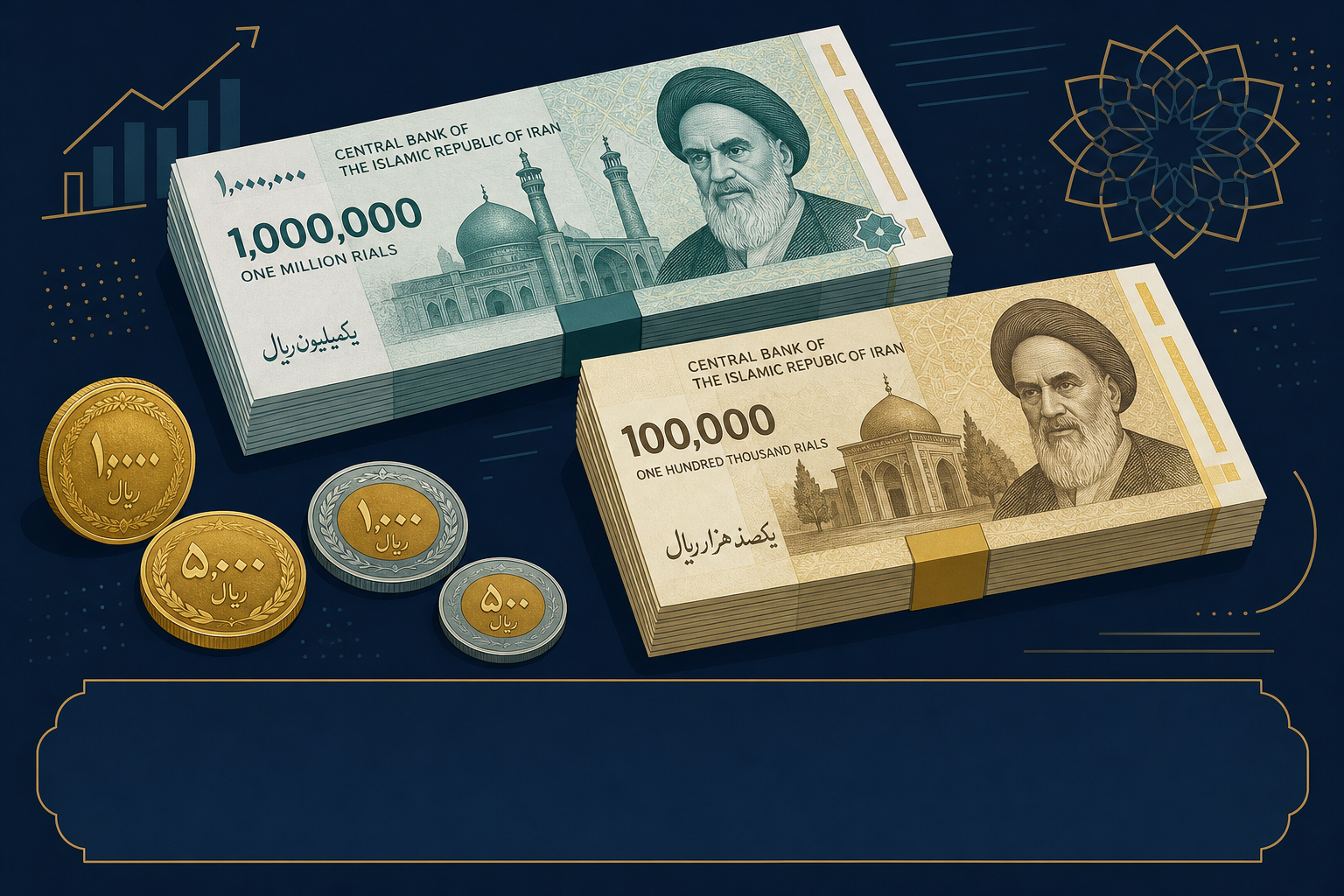
Common banknotes (Rial face value)
Widely used notes include:
- 20,000 Rials (2,000 Toman)
- 50,000 Rials (5,000 Toman)
- 100,000 Rials (10,000 Toman)
- 500,000 Rials (50,000 Toman)
- 1,000,000 Rials (100,000 Toman)
Notes are printed by Iran's banknote mint and include modern security features.
Common coins
Circulating coins include 1,000, 2,000, and 5,000 Rial pieces (100, 200, and 500 Toman equivalents). Very small denominations such as 250 and 500 Rials have largely disappeared from practical trade.
What is an Iran Cheque?
An Iran Cheque (*Iran Chek*) is a Central Bank–issued guaranteed cheque used almost like high-denomination cash. Denominations such as 500,000, 1,000,000, and 2,000,000 Rials help settle larger transactions without carrying stacks of notes.
Highest and lowest units
The largest commonly used instrument today is often the 2,000,000 Rial Iran Cheque (200,000 Toman). The smallest legal subdivision is the dinar, theoretically one-hundredth of a Rial — but it has been meaningless in practice for decades.
Challenges facing the Rial
Loss of purchasing power
Decades of high inflation have sharply reduced the Rial's real value. For households and expats sending support home, this shows up as rising prices for food, rent, and imported goods — and as a widening gap between the free-market dollar and the official transfer rate. See our guide on Iran's dual dollar rates for context.
Confusion in trade and travel
Dual counting units increase error risk — especially for foreign visitors and offshore analysts reading Iranian prices for the first time. Extra zeros also complicate spreadsheets, remittance apps, and mental math on quick phone calls.
Future plans: removing zeros
To simplify the system, Iranian lawmakers have discussed redenomination — dropping several zeros and rebranding the official unit.
The four-zero removal proposal
In May 2020, Iran's parliament approved the broad outlines of a plan to remove four zeros from the currency and make Toman the official unit. Under that framework, one "new Toman" would equal 10,000 current Rials (1,000 current Toman). A sub-unit called qiran was also proposed at 1/100 of the new Toman.
Implementation status
Despite legislative approval, full rollout has been delayed. Redenomination requires stable macro conditions, updated banking software, new note printing, public education, and a careful transition window. No fixed public date for complete implementation has been announced.
Lessons from other countries
Turkey removed six zeros from the lira in 2005; Venezuela has redenominated multiple times. These cases show that technical currency change is easier than restoring confidence — success depends on inflation control and credible policy, not just deleting zeros.
Digital money in Iran
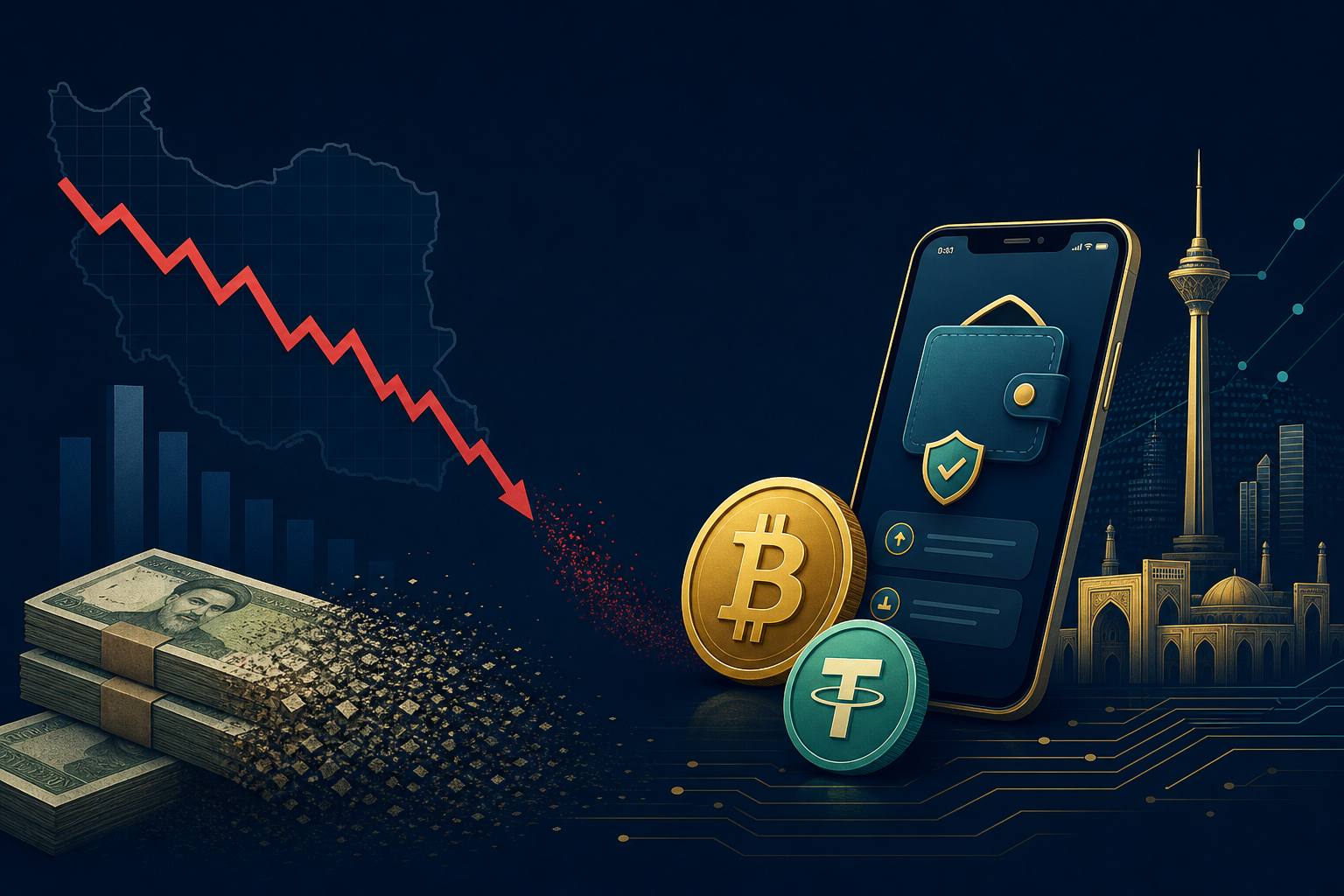
Alongside traditional cash, digital assets have grown in importance — especially for Iranians dealing with sanctions, capital controls, and Rial volatility.
Why crypto gained traction
Many Iranians turned to Bitcoin, Ethereum, and especially stablecoins such as USDT as alternative stores of value and payment rails. Drivers often cited Rial depreciation, limited access to global banking, and the need to move value across borders outside traditional channels.
Local exchanges
Iranian platforms such as Nobitex, Tabdeal, Bitpin, and Tetherland grew with Persian-language interfaces, local payment onboarding, and wallet services. Activity levels fluctuate with regulation and market conditions.
National digital currency efforts
Iranian authorities have explored state-backed digital money projects, including gold-backed concepts developed with domestic banks. Regulation remains evolving; treat any "national crypto" announcement as a policy work-in-progress rather than a finished retail product.
Not financial advice. Crypto and digital-rial projects carry regulatory, custody, and volatility risks. This section describes market context, not investment recommendations.
Practical tips for expats and visitors
Fast conversion cheat sheet
- Rial → Toman: remove one zero — 500,000 IRR = 50,000 Toman
- Toman → Rial: add one zero — 20,000 Toman = 200,000 IRR
- IRR on our site → Toman: divide by 10
Use the calculator when you need exact cross-rates against USD, EUR, or gold.
Tips for foreign visitors
- Assume spoken prices are Toman unless the seller says "rial."
- Card charges and ATM receipts will show Rial.
- Confirm the unit before paying — especially for taxis, accommodation, and market stalls.
Tips for everyday transactions inside Iran
- Conversation and shop windows: usually Toman
- POS terminals and bank SMS alerts: Rial
- Formal contracts and government fees: Rial
- When comparing to USD abroad, convert from IRR first, then to dollars using a live rate — not from an informal Toman figure alone
Conclusion
Iran's Rial–Toman split is not a modern glitch — it is the legacy of a 1930 reform that never fully reached everyday speech. For expats and analysts abroad, the practical rule is simple: trust IRR in data and banking, expect Toman in conversation, and always confirm before you pay.
Redenomination may eventually make Toman official again and remove some zeros — but until then, mastering the 10:1 conversion is essential for reading live rates, following family updates, and avoiding costly mistakes.
This article is informational only — not financial, legal, or tax advice.
FAQ
What is Iran's official currency?
Iran's official currency is the Iranian Rial (IRR). All legal accounting and banking settlement uses Rial.
What is the difference between Rial and Toman?
One Toman equals ten Rials. Rial is official; Toman is the informal unit Iranians use in daily speech and mental pricing.
Why does Iran use both Rial and Toman?
After the Rial replaced the qiran in 1929, people kept counting in Toman out of habit. The state standardized Rial; society kept Toman in conversation.
What was Iran's currency before the Rial?
The formal unit before 1929 was the qiran. Toman functioned as a larger counting unit equal to ten qirans.
What was the first unified Iranian money?
The Daric gold coin of the Achaemenid period is often cited as Iran's first major unified coinage.
What is the highest denomination in circulation?
The 2,000,000 Rial Iran Cheque (200,000 Toman) is among the largest commonly used instruments today.
Why is Toman unofficial if everyone uses it?
Iranian law defines the Rial as the monetary unit. Toman persists as custom and shorthand, not as a separate legal currency code.
How do I convert prices on Iran Market Data to Toman?
Divide any IRR figure by 10. Example: 18,180,000 IRR ≈ 1,818,000 Toman.
Will Toman replace the Rial officially?
Parliament has approved a redenomination framework that would adopt Toman and remove four zeros, but full implementation has been delayed with no fixed date announced.